

Ocean: Building and Maintaining an HPC Software Distribution
Speaker: Quentin Aniere (CEA)
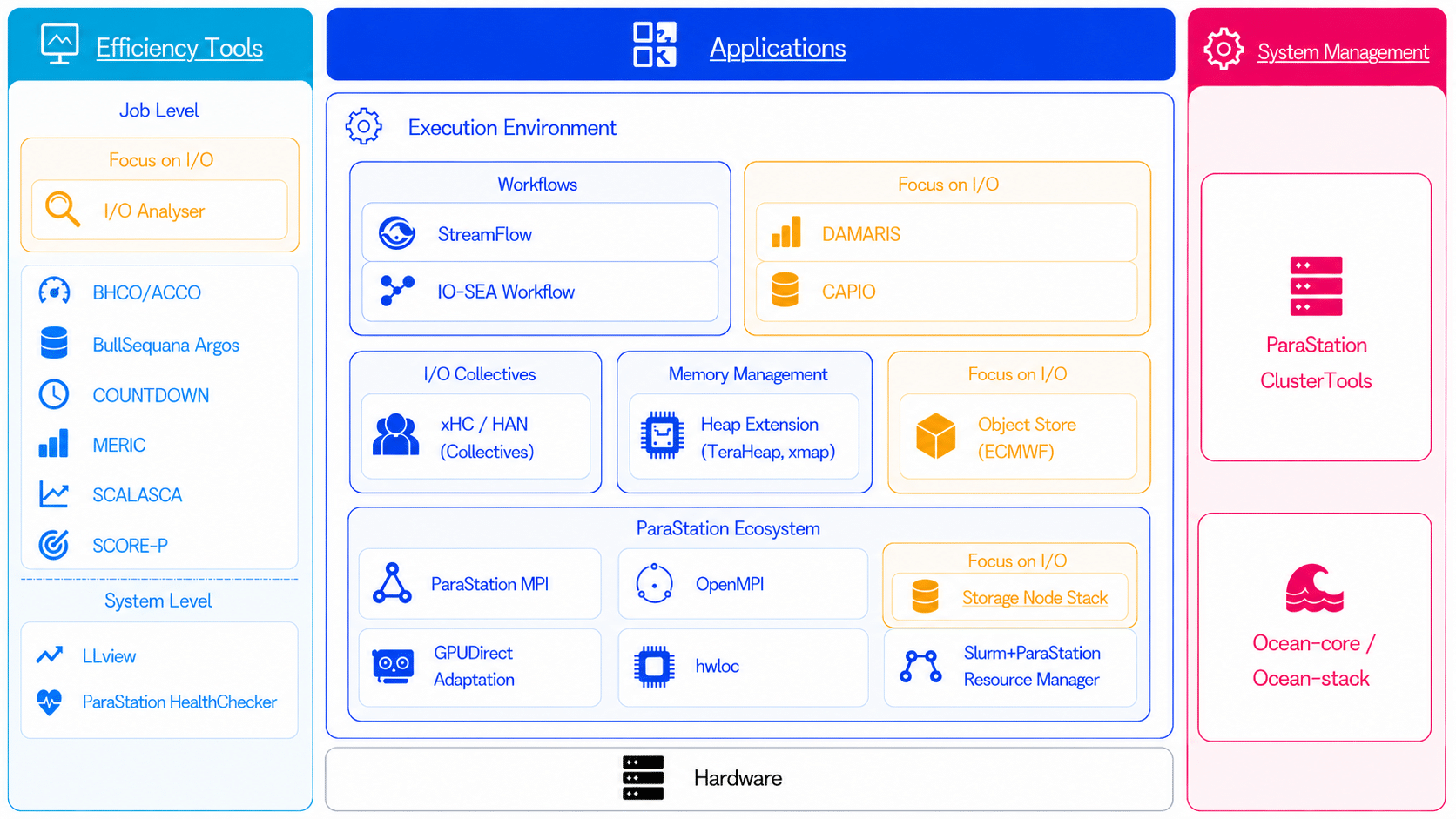
This presentation introduces Ocean, an HPC software stack used within the EUPEX project to support the deployment and administration of HPC systems. The talk will highlight how Ocean helps integrate and manage software components in a reproducible distribution, and will present the tools used to build, maintain, and contribute to the stack.
ParaStation MPI: A Scalable Execution Environment and Runtime for Modular Supercomputers
Speaker: Simon Pickartz (ParTec)
Modular supercomputers combine compute, accelerator, and I/O resources by integrating this heterogeneity at the system level. This creates new challenges for efficient resource management, communication, and application execution. ParaStation MPI is a modularity-aware execution environment and runtime designed to address these challenges at scale and is a core component of the EUPEX software stack.
This talk presents recent advances in ParaStation MPI, focusing on scalable startup and MPI Remote Memory Access (RMA). We discuss a hierarchical runtime initialisation approach that enables efficient startup of large-scale MPI applications on modular systems, reducing overhead and improving scalability. We also present optimisations for RMA communication that exploit hardware support to accelerate one-sided communication operations.
The talk further highlights the integration of ParaStation MPI within the EUPEX software ecosystem, including support for accelerator resources, device-to-device communication, and modularity-aware communication optimisations. Together, these capabilities establish ParaStation MPI as a key runtime technology for future modular supercomputers, providing the scalability, performance, and flexibility required by next-generation HPC applications.
ARGOS: Insights for Applications Running in Production Environments
Speaker: Philippe Couvée (Bull)
Ensuring that HPC applications run efficiently on supercomputers in production environments is far from trivial. Application efficiency can be affected by numerous factors within the runtime stack — from process distribution across compute nodes and memory utilisation to communication library settings and the GPU computing environment. Beyond the application itself, efficiency can also be impacted by other workloads competing for shared resources such as the network and file systems. In such production environments, users rarely have access to detailed metrics about their jobs, primarily due to the complexity of collecting this data and the overhead it introduces to resource usage.
BullSequana ARGOS is a tool specifically designed to address these challenges. It provides detailed, low-overhead metrics in the form of time series, presented both in job reports and through a graphical user interface. Data is collected in near real time, enabling live analysis of running jobs, while all metrics are stored in a database to support broader efficiency analysis for both end users and system administrators.
In this talk, we present the architecture of the tool and demonstrate how it provides actionable insights into application behaviour in real-world production environments.
Integrating Parallax KV Store with ECMWF’s Fields Database for High-Performance I/O
Speakers: Giorgos Saloustros (FORTH) & Phillipe Couvée (Bull)
Efficiently managing meteorological data at scale requires highly concurrent access to metadata, particularly for “in-flight” workflows where real-time reporting and analysis tasks must read from the database while the simulation is actively writing. This talk presents the integration of the ECMWF Fields Database (FDB) with Parallax, a specialized Key-Value store based on Log-Structured Merge-trees (LSM), running as a service within the IOSEA Flash Accelerator stack.
We contrast the legacy approach, which relies on file-based logs and POSIX synchronization to coordinate index consistency between producers and consumers, with a service-oriented model where the index lives natively within Parallax. By moving from a file-serialized index to a Flash-resident LSM-tree, we eliminate POSIX synchronization bottlenecks and provide a more efficient context for high-concurrency “read-while-write” patterns.
We will discuss the architectural integration and present preliminary results using the fdb-hammer benchmark.
Discussion & Q&A
The minisymposium will conclude with an open discussion on software integration, sustainability, maintenance, and adoption challenges for HPC software technologies in future European computing infrastructures.
Register Here >>>>>> https://2026.euro-par.org/